 Angkor Wat Tours
Angkor Thom: the Walled City of the Last Great Khmer King
Angkor Thom is the walled royal city that stands just north of Angkor Wat, and almost every temple tour from Siem Reap drives through its gates. The laterite walls run about 3 km on each side and stand 8 m high, with a moat outside them and five great gates topped by four-faced towers. Inside wait the Bayon with its stone faces, the Baphuon, Phimeanakas, the Royal Palace enclosure, the 350 m Terrace of the Elephants and the Terrace of the Leper King. This page covers the city itself: its size, its gates, its monuments, a walking order that makes sense of them, and which Angkor Wat tours stop here and for how long. For the Bayon temple in depth, see the Bayon temple page.
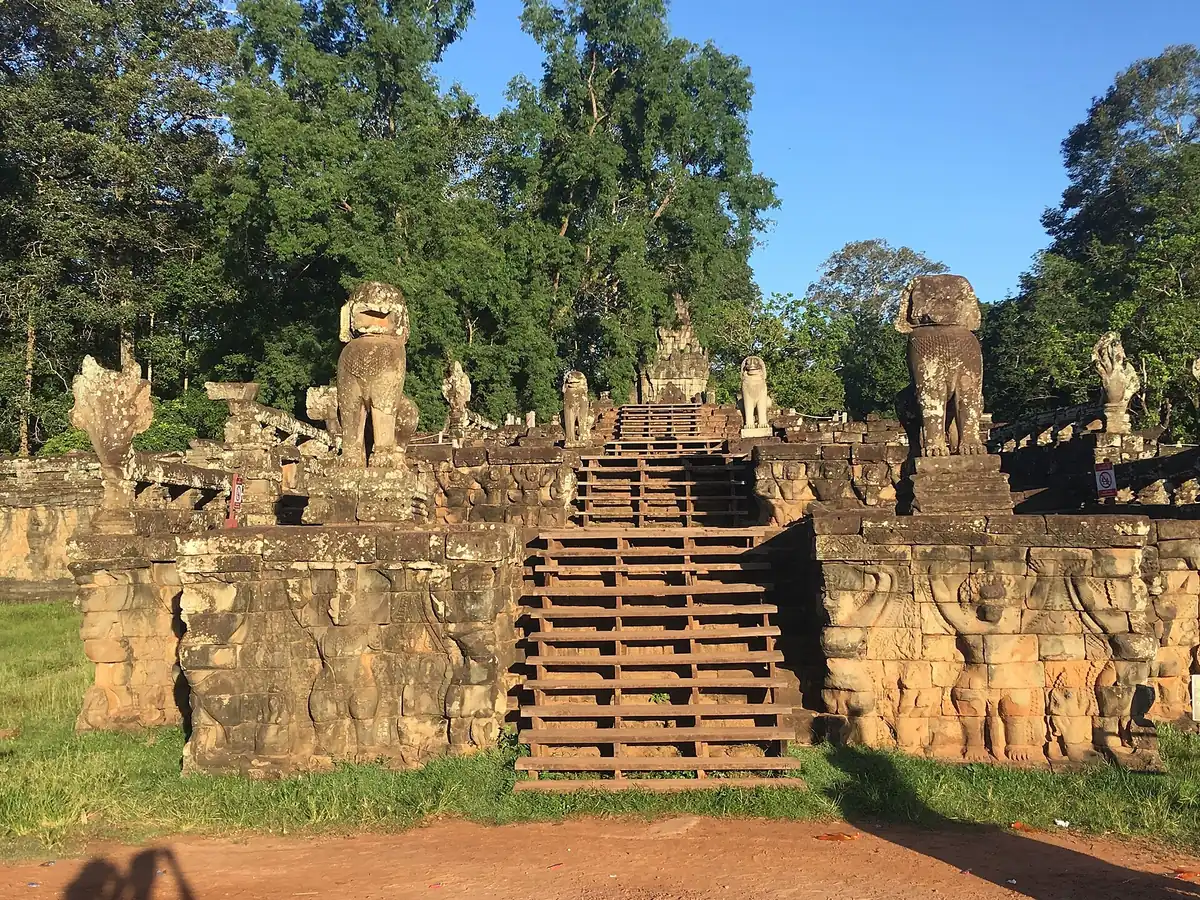
The Terrace of the Elephants in Angkor Thom with its central staircase and carved elephant trunks. Photo: Christophe95, CC BY-SA 4.0, via Wikimedia Commons
Quick answer Angkor Thom at a glance
Angkor Thom is a walled city of about 9 km2 in the heart of the Angkor Archaeological Park, founded by King Jayavarman VII in the late 12th century. Its laterite walls stand 8 m high and run about 3 km on each side, with a gate at each compass point plus the Victory Gate. Entry is covered by the Angkor Pass, which the official Angkor Enterprise site sells at US$37 for one day, US$62 for three days and US$72 for seven days. Tours that stop here usually visit the Bayon, the Baphuon and the terraces.
Key takeaways
- See how the walled city fits into a day with the Angkor Wat Small-Group Sunrise Tour, $15 per person with the Angkor Pass extra.
- Prefer a private day? The Private Angkor Temple Highlights Tour covers the South Gate, the Bayon, the Baphuon, Phimeanakas and both terraces in 7 hours.
- Compare every option on the homepage, from the sunrise and small-group tours to private tours by tuk-tuk or car.
- The faces inside the walls get their own page: read the Bayon temple guide.
The Walled City
Angkor Thom was the last and largest capital of the Khmer Empire, and its scale still surprises people who arrive expecting a single temple.
A City of 9 Km2 Behind an 8 M Wall
Angkor Thom is not one monument but a whole city. The laterite walls stand 8 m high and run about 3 km along each side, enclosing about 9 km2 (Wikipedia). Outside the walls lies a moat, and inside were the Royal Palace, temples, terraces and the homes of the court.
By comparison, the nearby Angkor Wat complex is a single temple enclosure, so the two are different kinds of place. If you are weighing up the difference, the Angkor Wat guide covers the temple in detail.
Jayavarman VII and the Late 12th Century
The city was founded by Jayavarman VII, who reigned from 1181 to 1218 (Wikipedia). He was the most prolific builder in Khmer history: the same king raised Ta Prohm, Preah Khan, Neak Pean and the Bayon, and is credited with 102 hospitals and 121 rest houses (Wikipedia). Angkor Thom was his capital, and at its centre he set his state temple, the Bayon.
The city remained in use after his death, and the Baphuon was even converted with a huge reclining Buddha around 1430 to 1440 (Wikipedia).
What You Need to Enter
There is no separate ticket for Angkor Thom. The Angkor Pass covers it, along with more than 50 temples in the park (Angkor Enterprise). The pass costs US$37 for one day, US$62 for three days and US$72 for seven days on the official Angkor Enterprise site.
Park entry runs from 5:00 AM to 6:30 PM on all three passes (Angkor Enterprise). Children under 12 enter free with their passport (Wikivoyage). None of the tours compared on this site include the pass, so budget it on top of the tour price every time.
Shrines at the Corners
Sandstone shrines called Prasat Chrung stand at the four corners of the city walls, dedicated to Avalokiteshvara (Wikipedia). No tour on this site lists them as a stop. The Angkor Sunrise Cycling Tour rides along the Angkor Thom wall, though its listed stops are Angkor Wat, Ta Prohm and the Bayon.
Sources: Wikipedia, Angkor Thom, Angkor Enterprise, Wikivoyage.
The Bayon in Brief
The Bayon stands at the exact centre of Angkor Thom, facing east, and it is the temple most people come for.
Face Towers and Galleries
The Bayon has three tiers: an outer gallery, an inner gallery and an upper terrace with a central tower that rises 43 m. Wikipedia counts 49 face towers originally with 37 remaining, and gives about 200 faces in one passage and 216 in another, depending on how partly preserved faces are counted. Wikivoyage says 54 towers with four faces each and 216 faces in all, so the two counts conflict.
Scholars have proposed the faces show Jayavarman VII, the bodhisattva Avalokiteshvara, or both. The outer gallery carries more than 1 km of reliefs with armies, naval battles against the Cham, markets and palace scenes. The inner gallery, added under Jayavarman VIII, shows mainly Hindu myth scenes.
The central Buddha statue is 3.6 m tall and was recovered from a well in 1933. Since 1995 the Japanese Government Team for the Safeguarding of Angkor has been the main conservation body. Our full Bayon temple guide goes deeper.
Best Light for the Faces
Wikivoyage says the Bayon is best from about 10:00 to 16:00, because the tall towers leave the faces in shadow early and late. Enter from the east. Many tours solve this by pairing the sunrise at Angkor Wat with a later Bayon, which is what the Angkor Wat Small-Group Sunrise Tour and the private Angkor Wat Sunrise Private Tour do.
Both visit the Bayon inside Angkor Thom, and neither includes the Angkor Pass, which you buy separately (US$37 for one day on the official site).
Source: Wikipedia, Wikivoyage.
How the City Rose and Emptied
Jayavarman VII made Angkor Thom the last great capital of the Khmer Empire, and the city did not keep that role for long.
A Capital of 80,000 to 150,000
Wikipedia estimates the city sustained a population of 80,000 to 150,000 people. Indochinatravel puts the figure at more than 100,000, which sits in the same range. Siemreap.net goes far higher and says about one million, a number Wikipedia does not support.
The laterite walls enclose 9 km2, and Wikipedia and Indochinatravel agree on the lower counts. Jayavarman VII reigned from 1181 to 1218 and also built Ta Prohm, Preah Khan, the Bayon and Neak Pean, along with 102 hospitals and 121 rest houses across his kingdom.
Sack, Move and Silence
Wikipedia records that the Ayutthaya Kingdom sacked Angkor Thom under Borommarachathirat II. After that, Ponhea Yat moved the capital to Phnom Penh. The city emptied out completely.
By 1609 it was uninhabited, and an early Western visitor who saw it compared it to the Atlantis of Plato. The stone city outlived its people. The South Gate now sits 7.2 km north of Siem Reap and 1.7 km north of the Angkor Wat entrance, about 30 minutes from the town centre.
For temples built before and after the capital, the guides to Preah Khan and Ta Prohm pick up the story.
Source: Wikipedia, Indochinatravel, Siemreap.net.
The Five Gates
Angkor Thom has gates at each cardinal point plus the Victory Gate in the east wall. Each gate tower rises 23 m and carries four giant faces, and each gateway passage is 3.5 m wide and 7 m high (Wikipedia).
Which Gate Is Which
The table below sets out the gates as Wikipedia and Wikivoyage describe them. Sources differ slightly in how they count: Wikipedia describes gates at each cardinal point plus the Victory Gate 500 m north of the east gate, while Wikivoyage describes five entrance gates plus the Victory Gate in the east wall. Either way, you pass through one of them in a vehicle on almost every visit, because the roads of the Small Circuit and the Grand Circuit run through the walls.
| Gate | Side | Note |
|---|---|---|
| South Gate | South | The gate most tours use, on the road from Angkor Wat. Causeway lined with gods and demons. |
| North Gate | North | Wikivoyage notes the Big Circuit exits the city by this gate. |
| West Gate | West | Gate in the west wall. |
| East Gate | East | Also called the Gate of the Dead (Wikipedia). |
| Victory Gate | East wall | 500 m north of the east gate (Wikipedia). Wikivoyage notes the Little Circuit exits by it. |
| Gate passage | All | Each gateway is 3.5 m wide and 7 m high, the tower above is 23 m tall (Wikipedia). |
The South Gate Causeway
The South Gate is the entrance that tour itineraries name. A causeway crosses the moat flanked by rows of stone figures carrying the body of a serpent, the gods on one side and the demons on the other in the famous churning scene. Tours such as the Angkor Wat Small-Group Sunrise Tour list the Angkor Thom South Gate explicitly among their stops, so it is on that route.
Tuk-tuks and the Gates
The gate passages are only 3.5 m wide and 7 m high (Wikipedia). Wikivoyage says the Little Circuit leaves the city by the Victory Gate and the Big Circuit by the North Gate.
The Moat and the Wall on Foot
Siemreap.net gives the moat as 100 m wide and the wall as 12 km around in total. Wikipedia gives 8 m high laterite walls about 3 km long on each side. Wikivoyage reports that walking the full wall circuit is about 13 km and takes around 3.5 hours, and warns that the condition of the path varies along the way, so treat the walk as a project rather than a stroll.
Most visitors skip it and cross the moat only on the causeway into the South Gate by tuk-tuk or bicycle.
Sources: Wikipedia, Angkor Thom, Wikivoyage.
Gate Faces and the Churning Causeway
Every gate into Angkor Thom tells the same myth in stone, and the faces on the towers still have no settled meaning.
Devas, Asuras and a Naga
A row of devas stands on the left of each gate causeway and asuras on the right, each holding a naga as in a tug of war. The scene refers to the Churning of the Sea of Milk, the Hindu creation myth in which gods and demons pull on a serpent to churn the ocean. The Bayon sits at the centre of the city as the pivot of the whole design.
On the south causeway the figures are often described as 54 devas and 54 asuras, a count from Living in Cinnamon's travel blog that Wikipedia does not confirm, so count them yourself as you walk. Prasat Chrung shrines dedicated to Avalokiteshvara stand at the city's corners.
Whose Faces
Each gate tower rises 23 m above a gateway 3.5 m wide and 7 m high. Wikipedia says the giant faces on the towers may represent the king, Avalokiteshvara or the guardians of the cardinal points, and no source settles the question. The same ambiguity applies inside the walls.
Compare them with the faces of the Bayon temple from the causeway first, then decide for yourself.
Source: Wikipedia, Living in Cinnamon.
Inside the Walls
Beyond the Bayon, the walled city holds a pyramid temple, a royal palace platform, a hilltop sanctuary with a legend, and two long carved terraces. The table compares what each one is and when it was built, using the figures given by Wikipedia.
The Monuments at a Glance
The table lists the five monuments this page owns, with their dates as the sources give them. Two were built before Jayavarman VII founded the city around them, which is why the Baphuon and Phimeanakas are older than the walls that now enclose them.
| Monument | What it is | Built |
|---|---|---|
| Baphuon | Three-tier temple mountain to Shiva, 120 m by 100 m at the base and 34 m tall without its tower | A 2015 radiocarbon study points to Suryavarman I (r. 1010-1050) rather than Udayadityavarman II |
| Phimeanakas | Three-tier pyramid inside the Royal Palace, scene of the legend of the nightly Naga | Begun by Rajendravarman (941-968), completed by Suryavarman I at the end of the 10th century |
| Royal Palace | Palace enclosure north of the Bayon near Victory Square, with Phimeanakas inside it | Phimeanakas stands inside the enclosure |
| Terrace of the Elephants | Reviewing stand 350 m long, where the king watched ceremonies and his returning army | Reviewing stand, no build date given here |
| Terrace of the Leper King | Terrace in the north-west of the Royal Square with a statue, today a replica in place | Bayon style under Jayavarman VII, a 14th-15th century inscription links the statue to Yama |
The Baphuon
The Baphuon is the biggest sight inside the walls after the Bayon. Its base measures 120 m by 100 m and it stands 34 m tall even without its lost tower (Wikipedia). Its restoration is a story of its own: the French-run EFEO dismantled the temple block by block, the work was abandoned in 1970 with about 300,000 numbered blocks spread over 10 hectares and the plans lost, and a 16-year restart finished in April 2011, with the temple reopened on 3 July 2011.
A reclining Buddha was built into its west side around 1430 to 1440.
Phimeanakas and the Royal Palace
The Royal Palace stood north of the Bayon near Victory Square, and Phimeanakas was incorporated into it (Wikipedia). The legend attached to the pyramid is one of the strangest in Angkor: kings were said to spend the first watch of every night in the tower with a woman believed to be a Naga, and calamity would strike the kingdom if a king failed the visit (Wikipedia).
Terrace of the Elephants
The Terrace of the Elephants is 350 m long and served as a reviewing stand for ceremonies and for the king watching his army return (Wikipedia). Elephants are carved on the eastern face, life-size garudas and lions run along the middle of the wall, and each end shows a parade of elephants with their Khmer mahouts. You walk it quickly, but the carvings reward a slow pass on the section nearest the centre.
Terrace of the Leper King
A short walk north along the wall brings you to the Terrace of the Leper King, in the north-west corner of the Royal Square. The statue is Bayon style, from the reign of Jayavarman VII, and the figure standing there today is a replica (Wikipedia). The name came from moss and discoloration that made the statue look diseased, tied to a legend that King Yasovarman I had leprosy, but a 14th-15th century inscription links the figure to Dharmaraja, an epithet of Yama, the god of death.
The Bayon in One Paragraph
At the exact centre of Angkor Thom stands the Bayon, Jayavarman VII's state temple, with its face towers and more than 1 km of bas-reliefs (Wikivoyage). Wikipedia counts 49 face towers once, of which 37 remain, and about 200 faces, while Wikivoyage gives 54 towers and 216 faces, so the counts differ by source. Its central tower rises 43 m.
The temple deserves its own visit plan, best light and gallery-by-gallery detail, which you will find on the Bayon temple page.
Preah Palilay and the Leper King Original
Two details complete the monument list. Preah Palilay, in the north-west of the walled city, is a quiet temple with trees overhanging the ruins, and Siemreap.net names it as a peaceful stop inside the walls. At the Terrace of the Leper King, the statue standing on the terrace today is a replica.
Siemreap.net says the original is in the National Museum of Phnom Penh. The statue here is a copy of one linked by a 14th-15th century inscription to Dharmaraja, an epithet of Yama, the god of death. The name Leper King came from moss and discoloration on the figure that resembled leprosy.
Sources: Wikipedia, Baphuon, Wikipedia, Phimeanakas, Wikipedia, Terrace of the Elephants, Wikipedia, Terrace of the Leper King, Wikivoyage.
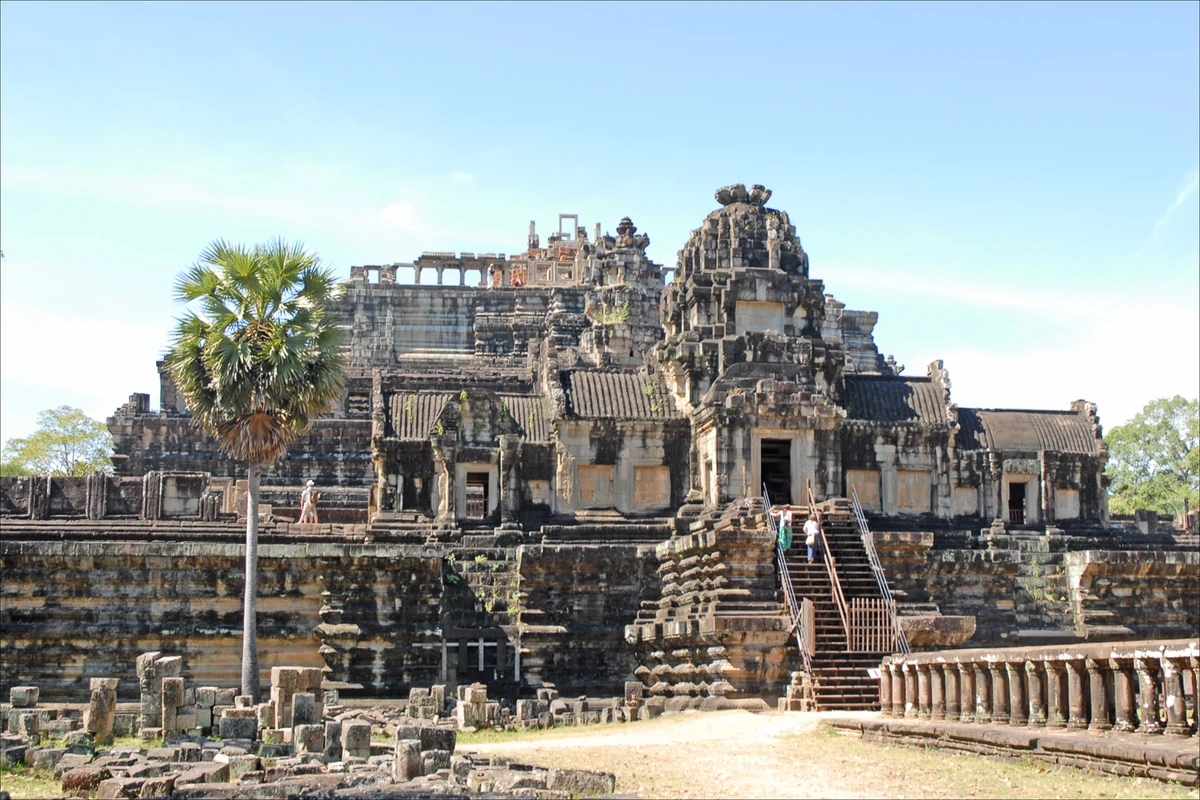
The restored eastern facade of the Baphuon temple pyramid. Photo: Jean-Pierre Dalbéra from Paris, France, CC BY 2.0, via Wikimedia Commons
Walking Angkor Thom
Angkor Thom rewards an order of visit. Arrive through the South Gate, work north from the Bayon, and leave by the Victory Gate or the North Gate depending on your next stop.
The Route That Works
The usual order is to enter by the South Gate over the causeway of gods and demons, drive straight to the Bayon at the centre of the city, then continue north to the Baphuon, the Royal Palace enclosure with Phimeanakas, and the Terrace of the Elephants, finishing at the Terrace of the Leper King. From there the Victory Gate exit puts you on the Little Circuit towards Ta Prohm and Srah Srang, which is exactly the sequence used by tours such as the Private Angkor Temple Highlights Tour, whose itinerary runs South Gate, Bayon, Baphuon, Phimeanakas, both terraces, then Victory Gate. Wikivoyage confirms the Little Circuit exits the city by the Victory Gate and the Big Circuit by the North Gate.
How Long You Get Here
Time on site depends on the tour. A fast morning circuit such as the Private Angkor Wat Ta Prohm Angkor Thom Tour compresses Angkor Wat, Ta Prohm and Angkor Thom into 4 to 5 hours, so the walled city gets a shorter stop. Full-day tours of 7 to 9 hours give the Bayon and the terraces a fuller block.
Day 1 of the Angkor Wat 3-Day Tour combines Angkor Wat, Ta Prohm, Ta Nei, the walled city (Bayon, Baphuon, Royal Enclosure, Phimeanakas and the Terraces) and Phnom Bakheng.
Which Tours Spend Longest Inside the Walls
If Angkor Thom is your priority, these are the tours whose itineraries name the city and its monuments directly. Remember that none of these prices includes the Angkor Pass, which Angkor Enterprise sells at US$37 for one day and US$62 for three days.
- The Private Angkor Temple Highlights Tour spends a 7-hour day on the city: South Gate, Bayon, Baphuon, Phimeanakas, Terrace of the Elephants, Terrace of the Leper King and Victory Gate. $31 per person, and the $37 pass is paid onsite, giving a you-pay total of $68.
- The Private Angkor Wat Ta Prohm Angkor Thom Tour is a 4 to 5 hour private SUV sunrise day, $75 per person plus the $37 pass at checkout, so $112 in total. It suits travelers who want the three headline sights only.
- The Angkor Wat 3-Day Tour covers the walled city on day 1 (Bayon, Baphuon, Royal Enclosure, Phimeanakas and the Terraces) alongside Angkor Wat and Ta Prohm, at $241.75 per person with the $62 three-day pass added, so $303.75.
- The Angkor Wat Small-Group Sunrise Tour covers the South Gate, Baphuon and both terraces after its sunrise, at $15 per person plus the $37 pass, $52 in total per its listing.
- The Private Angkor Sunrise Tour names the Bayon, the Terrace of the Elephants and the Terrace of the Leper King on a 7-hour private day at $30 per person, with the Angkor Pass paid in cash at the ticket office.
Timing and Heat
Wikivoyage says the Bayon is best from about 10:00 to 16:00, which lines up well with a mid-morning arrival through the South Gate after an early Angkor Wat sunrise. The park opens at 5:00 AM and closes at 6:30 PM on all passes (Angkor Enterprise). Carry water and a hat in the middle of the day.
The dress code applies here as everywhere in the park: long trousers or a long skirt and covered shoulders, and a scarf over bare shoulders is not accepted (Wikivoyage).
Doing It Without a Tour
You can also see the walled city under your own steam. The Angkor Temples Bike Tour shows that the walls and the city roads work by bicycle, riding 30 km in a day through the forest tracks between Angkor Wat, the Bayon and Ta Prohm at $33 per person, pass not included, $70 with the pass per its listing. The Angkor Sunrise Cycling Tour rides the wall of Angkor Thom itself on a 15 to 25 km route at $69 per person, $106 with the pass.
For a self-guided tuk-tuk day, Wikivoyage quotes about US$15 for the main temples and US$20-30 for outlying ones, while Nomadic Matt quotes about US$25 per day for 3 to 4 people, so ask and agree the price before setting off. The homepage has the full comparison of Angkor Wat tours from Siem Reap if you would rather hand the driving to someone else.
Where the Prices Here Come from
All tour prices above are the US dollar card prices of the tours compared on this site, and the totals quoted are each tour's own stated price with the pass. Pass prices come from Angkor Enterprise.
Quieter Corners of the City
The south gate carries most of the traffic. Siemreap.net suggests entering by the west or north gate instead. The Next Crossing says few visitors climb the Baphuon, which you reach along a 200 m elevated walkway.
Siemreap.net also calls Preah Palilay in the north-west corner quiet, with trees overhanging the ruins, and names the south-west corner of the wall by the moat as a sunset spot. One warning from The Next Crossing applies everywhere in the park. Ignore unofficial guides who approach you at the gates, because they may charge for unwanted services.
The Angkor Temples Bike Tour follows forest paths to the Bayon and the Elephant Terrace, but its listing names none of these quieter stops.
Sources: Wikivoyage, Angkor Enterprise.
Angkor Thom: Questions and Answers
What is the difference between Angkor Wat and Angkor Thom?
Angkor Wat is a single temple enclosure, while Angkor Thom is an entire walled city of about 9 km2 with walls 8 m high and about 3 km per side, founded by Jayavarman VII in the late 12th century. Angkor Thom holds several monuments, including the Bayon, the Baphuon and the two terraces. The Angkor Wat guide covers the temple in depth.
Is Angkor Thom bigger than Angkor Wat?
Angkor Thom encloses about 9 km2 behind its walls and holds several monuments, while Angkor Wat is a single temple enclosure. Compare how tours combine the two sites in the comparison table of price and price with the pass.
What does Angkor Thom mean?
The name means Great City, from the Khmer words angkor (city) and thom (great), which fits a capital with 8 m walls and five great gates. The city and its monuments are covered on this page, starting with The Walled City.
Who built Angkor Thom?
Jayavarman VII founded Angkor Thom in the late 12th century, during his reign of 1181 to 1218 (Wikipedia). He also built the Bayon at its centre, along with Ta Prohm, Preah Khan and Neak Pean. The Angkor Wat 3-Day Tour covers his walled city on day 1 of its itinerary.
Do I need a separate ticket for Angkor Thom?
No. The Angkor Pass covers Angkor Thom and more than 50 temples in the park, at US$37 for one day, US$62 for three days and US$72 for seven days (Angkor Enterprise). Note that no tour price on this site includes the pass. The Angkor Wat tickets page explains where to buy it.
How long should I spend inside Angkor Thom?
A focused visit to the Bayon, the Baphuon, Phimeanakas and the two terraces fits inside a full-day tour of 7 to 9 hours. Wikivoyage rates the Bayon's best light from about 10:00 to 16:00. See how the timing works on a real itinerary with the Angkor Wat Full-Day Tour with Sunset, a 9-hour day at $14 per person plus the $37 pass.
Why was Angkor Thom abandoned?
Wikipedia records that the Ayutthaya Kingdom sacked the city under Borommarachathirat II, after which Ponhea Yat moved the capital to Phnom Penh. The city was uninhabited by 1609. The Angkor Wat 2-Day Tour visits the Bayon inside Angkor Thom on day one.
How many faces does the Bayon have?
The counts conflict. Wikipedia gives the Bayon 49 face towers originally, 37 remaining, and about 200 to 216 faces depending on how partial faces are counted. Wikivoyage says 54 towers and 216 faces. The Bayon temple guide sets out both counts.