 Angkor Wat Tours
Koh Ker: The Pyramid Capital of the Khmer Empire
Koh Ker served as the capital of the Khmer Empire from 928 to 944, and its seven-tier pyramid at Prasat Thom still rises 36 m above the forest of Preah Vihear Province. This guide covers the history, the temples worth seeing, the US$15 park ticket, the road from Siem Reap and the landmine and border warnings. It also looks at the only catalog day trip that names Koh Ker, the Koh Ker and Beng Mealea Temples Tour, and what its price really covers. If you are comparing Angkor Wat tours instead, the homepage has the full price table.
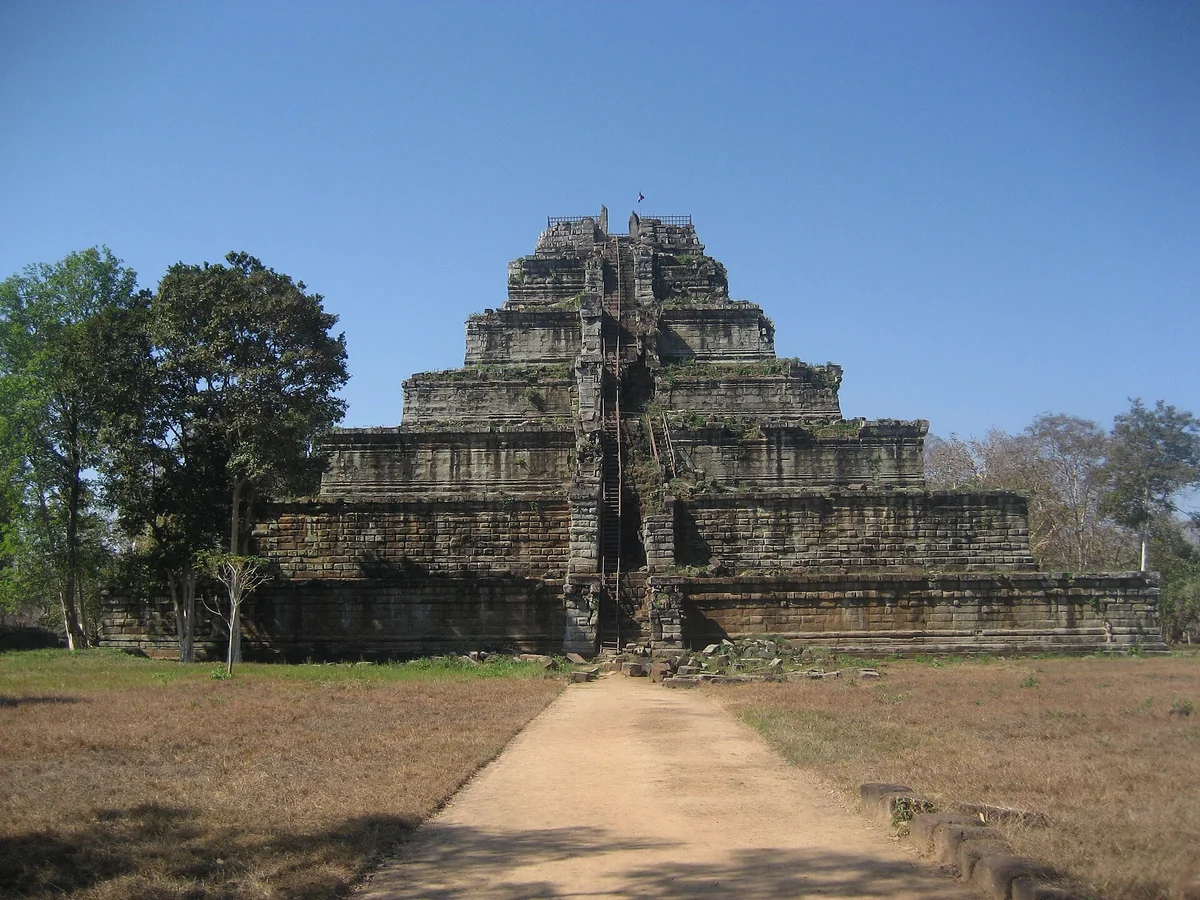
The stepped pyramid of Prasat Thom at Koh Ker under a blue sky. Photo: Arian Zwegers, CC BY 2.0, via Wikimedia Commons
Quick answer Koh Ker in brief
Koh Ker is a 10th century temple complex about 120 km from Siem Reap by Wikipedia's count, roughly two and a half hours by road, built when it was the Khmer capital from 928 to 944. Its centerpiece is the 36 m seven-tier pyramid at Prasat Thom. The park pass costs US$15 and covers 10+ temples from 6:00 AM to 6:30 PM. UNESCO inscribed the site on the World Heritage List on 17 September 2023.
Key takeaways
- Check the full Koh Ker and Beng Mealea tthis page for what the day trip includes and what you pay at the gate.
- Beng Mealea sits on the same route. See the separate Beng Mealea guide for its US$10 ticket and boardwalks.
- The official Angkor Wat tickets page explains which passes cover which areas, because the Angkor Pass does not cover Koh Ker.
- Compare every Angkor Wat tour by price and by what the price leaves out before you book anything.
The Short-Lived Capital
Koh Ker, known in the inscriptions as Lingapura, replaced Angkor as the Khmer capital for sixteen years in the 10th century.
Jayavarman IV and His Successor
Jayavarman IV took the capital away from the older center around 928 and built most of what stands at Koh Ker. He ruled until 941. His son Harshavarman II ruled from 941 to 944, and after that the court returned to the Angkor region. The whole capital episode lasted from 928 to 944.
The protected area covers 81 square kilometers and holds more than 180 documented sanctuaries. Only about two dozen are open to tourists. The Rahal baray, the water reservoir that served the city, measures about 1,200 m by 560 m.
A World Heritage Site Since 2023
UNESCO added Koh Ker to the World Heritage List on 17 September 2023, at the 45th session of the World Heritage Committee in Riyadh, under criteria ii and iv. The listing recognizes the site as the surviving capital of the Khmer Empire from the period 928 to 944.
The official Cambodian ticket site treats Koh Ker as its own park, separate from the Angkor Archaeological Park, with its own pass and its own gate hours.
Dates and Temple Counts: Sources Differ
The counts and dates around Koh Ker are not settled. The provincial authority, the National Authority for Preah Vihear, dates the start of construction to 921 CE, while the capital years usually given are 928 to 944. On the number of monuments, Explorehere puts the site at about 40 temples and All Points East at about 70, while Wikipedia and Wikivoyage count more than 180 documented sanctuaries across 81 sq km, with only about two dozen open to tourists.
Treat any single number as an approximation. Source: National Authority for Preah Vihear, Wikipedia.
Sources: Wikipedia, Koh Ker, Angkor Enterprise
What to See at Koh Ker
More than 180 sanctuaries stand inside the 81 square kilometer protected area, but only about two dozen are open to visitors. These are the ones most trips include. The table compares them by type and size, with figures from Wikipedia and Wikivoyage.
The Pyramid at Prasat Thom
Prasat Thom is the heart of Koh Ker and its seven-tier pyramid, called the Prang. It stands 36 m high on a square base 62 m per side. When built, it carried a lingam more than 4 m high on its top platform. The main complex around it holds 21 towers that once housed lingas.
The original steep stairs of the Prang are in poor condition and the old bamboo ladder route is forbidden, but Wikipedia says a newer staircase now gives access to the top. Wikivoyage's safety section still warns against climbing, so use only the staircase and check the rule at the site on the day. In the 10th century this was the state temple of an empire.
Prasat Krahom and the Linga Shrines
Prasat Krahom, the red temple, is a brick entrance tower at the start of the Prasat Thom complex. It once held a five-headed, ten-armed dancing Shiva that stood 3.50 m tall.
Linga worship defines the whole site, which is why the old name was Lingapura. Shrines across the park hold lingas about 2 m high. The inscription at Prasat Damrei describes one of about 4.5 m. Prasat Damrei itself, the elephant temple, is known for its elephant sculptures. Prasat Beng, a large jungle-covered complex, sits on the ring road.
The Temples Side by Side
The table lists the names you will meet on almost every visit, what each one is, and its recorded size. Figures come from Wikipedia and Wikivoyage.
| Temple | What it is | Size |
|---|---|---|
| Prasat Thom | State temple with the seven-tier pyramid called the Prang, plus 21 towers that once held lingas | Prang 36 m high on a base 62 m per side |
| Prasat Krahom | Red-brick entrance tower that once held a large dancing Shiva | Statue 3.50 m tall |
| Prasat Damrei | Elephant temple named for its elephant sculptures | Inscription describes a lingam of about 4.5 m |
| Prasat Beng | Large jungle-covered complex on the ring road | not stated |
| Rahal baray | Water reservoir serving the old capital | About 1,200 m by 560 m |
Sources: Wikipedia, Koh Ker, Wikivoyage, Koh Ker
Looted Statues and Where They Are Now
Much of the finest sculpture from Koh Ker no longer stands at Koh Ker, which explains the empty pedestals you walk past.
Where the Pieces Went
Wikipedia records that looters stripped the site from the 19th century on, sending sculpture to museums and private collections abroad. The famous statue of monkey kings from Prasat Chen and fragments from Prasat Pram are now in the National Museum in Phnom Penh, so a visit there fills in what is missing on site. In 2011 the auction house Sotheby's tried to sell a Khmer warrior statue from Koh Ker, whose twin stands in the Norton Simon Museum in Pasadena.
Recoveries of looted Khmer statues have continued since. The practical takeaway for a visitor is simple: the shrines hold their lingas, many about 2 m high, but the freestanding masterpieces have mostly gone, and the architecture itself is the reward.
Source: Wikipedia.
More Temples Beyond Prasat Thom
The 81 sq km site holds more than 180 documented sanctuaries, about two dozen of them open, and several sit along the road in and the ring road.
On the Road from Siem Reap
Wikipedia places Prasat Neang Khmau, an early 10th-century Shiva temple with blackened stone, about 12.5 km south of the main pyramid. Prasat Pram on the same road has five towers. On the ring road, Prasat Krachap has a well-preserved gate and the ruins of five brick towers set in quincunx order, dedicated in 928.
Prasat Chen has two enclosures and five inscriptions, and Prasat Bak and Prasat Kok Krong follow, with Kok Krong on the highest point of the site. On the ring road, Wikivoyage names Prasat Damrei, with its elephant sculptures, and Prasat Beng, a large complex reclaimed by the jungle. The provincial authority lists further monuments including Prasat Dang Tong, Prasat Ream Ker and Prasat Khtum.
The Koh Ker and Beng Mealea Temples Tour listing names Prasat Thom, Prasat Pram and Prasat Chrap under Koh Ker, though its stop list shows only Beng Mealea.
| Monument | What it is | Where |
|---|---|---|
| Prasat Pram | Five towers | Entrance road |
| Prasat Neang Khmau | Shiva temple, blackened stone | About 12.5 km south of the pyramid |
| Prasat Krachap | Five brick towers in quincunx, dedicated 928 (ring road, not the entrance road) | Entrance road |
| Prasat Chen | Two enclosures, five inscriptions | Entrance road |
| Prasat Damrei | Elephant sculptures | Ring road |
| Prasat Beng | Large jungle-covered complex | Ring road |
Source: Wikipedia, Wikivoyage, National Authority for Preah Vihear.
Can You Climb the Pyramid Now?
The rules for the 36 m Prang have changed over the years, and guides disagree.
The Staircase Situation
Wikipedia says the original steep stairs of the Prang are in poor condition, that the old bamboo ladder route is forbidden, and that a newer staircase now gives access to the top. Wikivoyage mentions a wooden staircase built in 2014, yet its own safety section still calls climbing the Prang dangerous and forbidden. The position is therefore mixed.
Check on arrival with the staff at the site and treat the built staircase, if it is open, as the only way up. Do not scramble on the original steps or anywhere else on the pyramid. The seven tiers rise 36 m on a base 62 m per side, so a fall would be serious either way.
Source: Wikipedia, Wikivoyage.
The Route Around the Site and How Long to Allow
Koh Ker is bigger than the pyramid, and a plan for the order of stops saves time on a long day.
How the Day Works
Wikivoyage allows 1-2 hours for the main temple complex around Prasat Thom, plus another 1-2 hours for the monuments along the entrance road and the ring road. Roowanders puts the ticket booth 3 km from the main complex, with the last 3 km on a forest gravel road, so buy your pass first and then drive on. Beng Mealea, usually combined on the way back, takes about 90 minutes more.
If you would rather not drive yourself, the Koh Ker and Beng Mealea Temples Tour runs 8 to 9 hours and names both sites in its title, though its itinerary lists only Beng Mealea.
- Roowanders calls Prasat Krahom, the red-brick entrance tower, the second-largest structure at the site and says it received less care than the pyramid
- Wikivoyage lists two open-air restaurants near the parking area, but no shops or restaurants along the ring road, so carry water
- In the rainy season the forest roads can need a 4WD, so ask your driver before setting out
Source: Wikivoyage, Roowanders.
Getting There, Ticket and Safety
Koh Ker is a long day from Siem Reap with no public transport, a separate US$15 ticket, and two safety warnings you should read before you go.
The Road from Siem Reap
Wikipedia puts Koh Ker about 120 km from Siem Reap, roughly two and a half hours by road. Wikivoyage agrees on the driving time but frames the distance differently, giving 120 km from Beng Mealea and placing Beng Mealea itself 80 km east of Siem Reap. Either way, plan on a full day out.
The route leaves Highway 6 at Dam Deik. The road to Koh Ker village is paved and the last stretch is unpaved but well kept, according to Wikivoyage. There is no public transport. Wikivoyage prices a taxi at about US$100. On the return, Koh Ker is usually combined with Beng Mealea, which you can read about in the Beng Mealea guide.
The Koh Ker Park Ticket
Koh Ker is a separate park from Angkor and the Angkor Pass does not cover it. The official ticket site, Angkor Enterprise, sells a 1-day Koh Ker Temples Park pass for US$15, valid for 1 day and covering 10+ temples. The park opens at 6:00 AM and closes at 6:30 PM.
The official site lists the same park among its separate areas alongside Angkor Wat, Preah Khan, Banteay Srei and others, which is the clearest sign that your main temple pass stops at the Angkor boundary. Budget the US$15 per person on top of whatever your transport or tour costs. The tour listing recommends carrying cash.
Landmines: Stay on the Cleared Paths
Wikivoyage warns that land mines are a danger at Koh Ker and that visitors should not enter forest outside cleared zones. The British Foreign, Commonwealth and Development Office gives the same advice for rural Cambodia generally. Its guidance says mined areas are often unmarked, so stay on main routes in rural areas, including around temple complexes.
In practice this is simple: walk the marked trails between the open sanctuaries and never follow paths into the trees, no matter how tempting a half-buried tower looks. With more than 180 sanctuaries in the reserve and only about two dozen cleared for visitors, the uncleared forest is exactly what the warning is about.
The Thai Border Advice
Koh Ker lies in Preah Vihear Province, which borders Thailand, so the FCDO border advice is relevant reading. The FCDO advises against all but essential travel to within 20 km of the Cambodia-Thailand land border. It says unexploded ordnance, including landmines, is present in the border area, and that tourist destinations in border areas such as the Preah Vihear temple are closed. Land borders and crossings between Cambodia and Thailand remain suspended according to the FCDO. It also warns that travel insurance could be invalidated if you travel against its advice.
Check the current FCDO travel advice for Cambodia before any trip into Preah Vihear Province.
Getting Around the Site and What the Road Costs
Wikivoyage adds a few figures worth knowing. In the rainy season the forest tracks can need a 4WD. A car with a guide for the day runs about US$140, and oxcart rides along the ring road are planned and would take about two hours for roughly US$10.
Wikivoyage also mentions US$5 for a short private road near Beng Mealea, which a US$100 taxi fare should already include. If you would rather leave the driving to someone else, the Koh Ker and Beng Mealea Temples Tour is $50 per person for 8 to 9 hours with hotel pickup, though its itinerary lists only Beng Mealea.
A Note on Older Figures
Some older blogs and guidebooks print a US$10 Koh Ker ticket and hours of 7:30 AM to 5:30 PM, which you may still see quoted online. The official Angkor Enterprise table says US$15 for the Koh Ker Temples Park pass, open 6:00 AM to 6:30 PM, If a driver or guesthouse quotes a different price or a later opening, the official table is the reference. Source: Angkor Enterprise.
Sources: Angkor Enterprise, Wikivoyage, Koh Ker, FCDO Cambodia
Staying Overnight Near Koh Ker
A day trip from Siem Reap means about two and a half hours of driving each way. A night near the temples shortens the driving.
Where to Sleep
Wikivoyage lists two places in Koh Ker village: the Hidden Cambodia Koh Ker Eco Lodge and Morokod Koh Ker Guesthouse, which has ten fan rooms and cold-water showers. Wikivoyage adds that an evening meal at the two restaurants near the parking area must be ordered in advance. Camping is not allowed at the temple site itself.
An overnight lets you reach the park for the 6:00 AM opening and see the main complex before the day trippers arrive. If you prefer to keep Siem Reap as your base, the Koh Ker and Beng Mealea Temples Tour runs the day from there, though its itinerary lists only Beng Mealea.
Source: Wikivoyage.
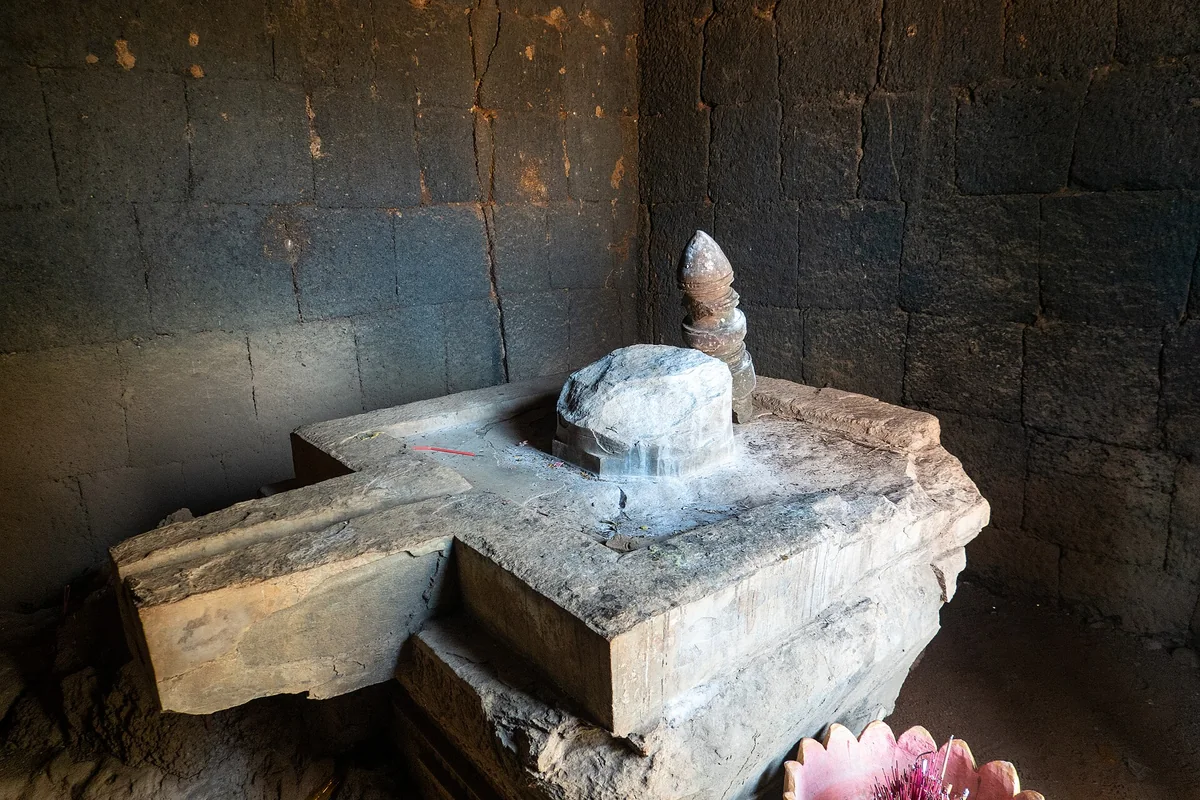
A linga on its base inside the dark stone sanctuary of Prasat Neang Khmau at Koh Ker. Photo: PsamatheM, CC BY-SA 4.0, via Wikimedia Commons
Koh Ker Tours
One day trip in the catalog names Koh Ker. Here is what it costs, what it includes, and the one thing you must confirm before booking it.
The Koh Ker and Beng Mealea Day Trip
The Koh Ker and Beng Mealea Temples Tour costs $50 per person and runs 8 to 9 hours in a small group of up to 10 people, with a private option for up to 3. It is rated 4.9 from 356 reviews and is not suitable for children under 12. The Angkor Pass is not in the price, and no tour in the catalog includes it.
The caveats matter. The listing's Includes list shows the Beng Mealea entrance fee with a note that an Angkor Wat ticket is required, and the Koh Ker entrance fee at USD 15, but it does not say who pays, so plan to pay both at the gates. The Koh Ker fee is US$15 and Beng Mealea has its own ticketing question, which the Beng Mealea guide covers. Most important: the listed itinerary names only Beng Mealea, so confirm with the operator that Koh Ker itself is visited before you book. An optional Thom Temple stop costs an extra fee.
Going Without a Tour
There is no public transport to Koh Ker. Wikivoyage prices a taxi at about US$100, plus the US$15 park pass per person. Some travelers hire a car and driver for the day and combine Koh Ker with Beng Mealea on the way back, which Wikivoyage says is the usual pattern. A private 3-day option in the catalog, the Angkor Wat 3-Day Tour, includes Beng Mealea on its third day but not Koh Ker, so read its site list carefully.
Whichever way you go, the figures that decide the day are the same: about US$100 for the car, US$15 for the Koh Ker pass, and the Beng Mealea ticket if you add that stop.
Sources: Wikivoyage, Koh Ker, Angkor Enterprise
Koh Ker: Common Questions
Where is the Koh Ker temple located?
Koh Ker sits in Preah Vihear Province, about 120 km from Siem Reap, roughly two and a half hours by road, with the last stretch unpaved but well kept. See the getting there section for the route and transport options.
How much does the Koh Ker ticket cost?
The official 1-day Koh Ker Temples Park pass costs US$15 per person, covers 10+ temples, and the park is open from 6:00 AM to 6:30 PM. The Angkor Wat tickets page explains how this differs from the Angkor Pass.
Why is there a pyramid at Koh Ker?
Jayavarman IV made Koh Ker the Khmer capital from 928 to 944 and built the seven-tier Prang as his state temple, 36 m high on a base 62 m per side, once topped by a lingam more than 4 m high. The temple list above compares the main monuments.
Is Koh Ker safe to visit?
Stay on the marked paths. Wikivoyage warns that land mines are a danger at Koh Ker and that visitors should not enter forest outside cleared zones. The FCDO adds that mined areas are often unmarked in rural Cambodia. The safety section has the full detail.
Can you climb the Koh Ker pyramid?
Only by the newer staircase. Wikipedia says it gives access to the top of the 36 m pyramid, while the old stairs and the bamboo ladder route are off-limits, and Wikivoyage still warns against climbing, so check the rule on the day. For temples you can climb, see the Angkor Wat map guide.
Is Koh Ker worth combining with Beng Mealea?
They are usually combined, since Wikivoyage says Koh Ker is paired with Beng Mealea on the way back. The Koh Ker and Beng Mealea Temples Tour runs 8 to 9 hours for $50 per person, though its itinerary stops list only Beng Mealea and the listing is unclear about who pays the entry fees.
How long do you need at Koh Ker?
Plan 1-2 hours for the main complex around Prasat Thom and another 1-2 hours for the monuments on the entrance road and the ring road, according to Wikivoyage. Combined with the drive from Siem Reap, it fills a day, and Wikivoyage says Beng Mealea is usually added on the way back. The Koh Ker and Beng Mealea Temples Tour pairs the two in its title, though its itinerary lists only Beng Mealea.
Is there public transport to Koh Ker?
No. Wikivoyage says there is no public transport to Koh Ker and puts a taxi at about US$100 for the roughly 120 km trip. Most visitors hire a car and driver, join the Koh Ker and Beng Mealea Temples Tour, or stay overnight near the temples.