 Angkor Wat Tours
Preah Khan: the Grand Circuit Temple of Jayavarman VII
Preah Khan is the vast 12th-century temple about 3 km north of Angkor Thom, built for King Jayavarman VII in honour of his father. This guide covers its history, its Hall of Dancers and two-storey building, its stele of 1191, the Grand Circuit day out with Neak Pean and Ta Som, and the tours that stop here. None of those tours includes the Angkor Pass. The bookable trips are compared on all Angkor Wat tours.
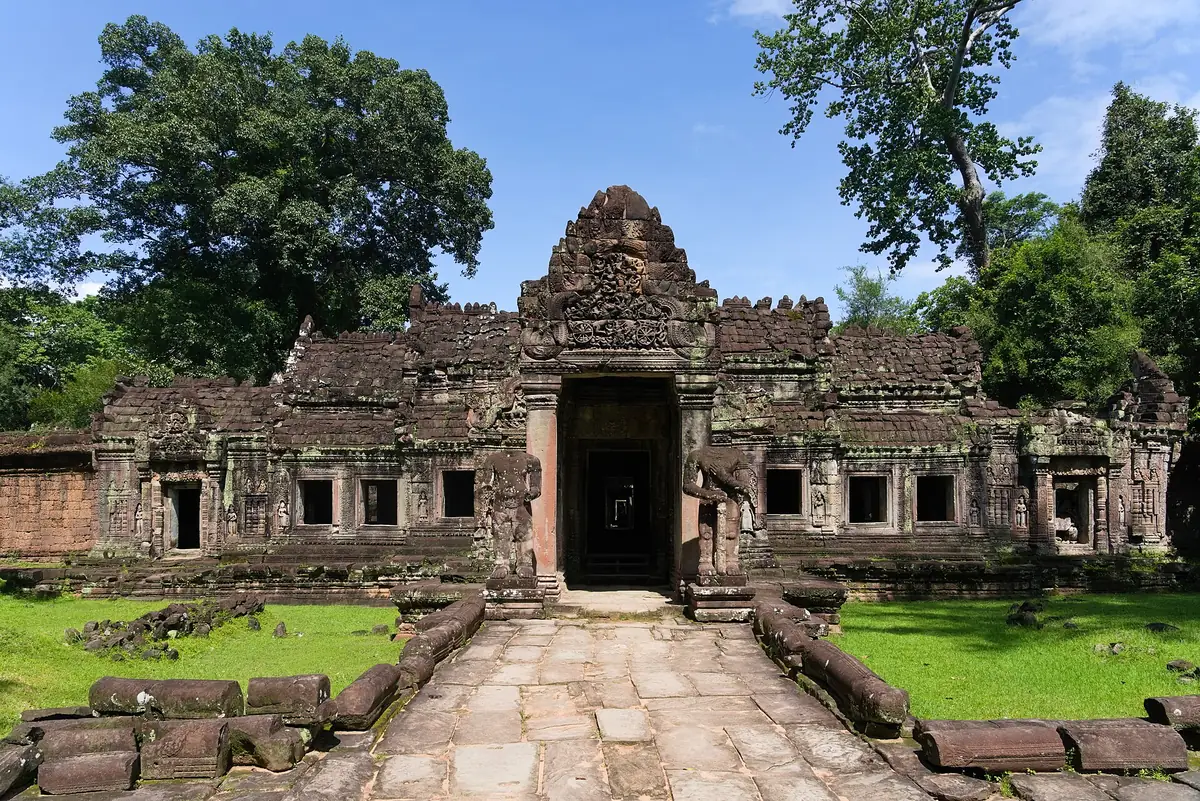
The entrance gopura and causeway of Preah Khan with a long gallery either side. Photo: Satdeep Gill, CC BY-SA 4.0, via Wikimedia Commons
Quick answer Preah Khan in brief
Preah Khan is a 12th-century temple about 3 km north of Angkor Thom, built for King Jayavarman VII in honour of his father, with its stele dating the main image's dedication to 1191. Entry needs the Angkor Pass, $37 for one day or $62 for three days on the official Angkor Enterprise site. No tour in the comparison includes the pass.
Key takeaways
- The Angkor Wat 2-Day Tour puts Preah Khan, Neak Pean and Ta Som on day two for $34 per person, pass not included.
- See how the Grand Circuit sits against the Small Circuit on the Angkor Wat map before you choose your day.
- Compare every option in one view in the Angkor Wat tours comparison table, including the total with the pass.
What Preah Khan Was
Preah Khan is one of the great temple cities of Angkor, and it was a working city in its own right rather than a single shrine.
The King, the Date and the Name
Preah Khan was built in the 12th century for Jayavarman VII, who reigned from 1181 to 1218. He raised it in honour of his father, and its stele dates the dedication of the main image to 1191. The same king built Ta Prohm, the Bayon and Neak Pean, along with 102 hospitals and 121 rest houses across his kingdom.
Visitors today reach the temple about 3 km north of Angkor Thom, on the Grand Circuit that loops away from the main small-circuit temples. The park opens from 5:00 AM to 6:30 PM on all three Angkor passes, so a Grand Circuit morning fits easily inside the official hours.
How Big Preah Khan Is
Come with water and a plan, because this is a big site. The outer wall forms a rectangle of about 800 m by 700 m and encloses roughly 56 hectares, and that laterite wall carries 72 garudas. The temple itself is flat, with successive rectangular galleries running around a central Buddhist sanctuary, and Hindu satellite shrines stand to the north, south and west.
The associated Jayatataka baray, the reservoir the temple faces, measures about 3.5 km by 0.9 km. Wikivoyage notes that Preah Khan draws fewer visitors than the main temples.
The Stele and What It Records
The foundation stele of Preah Khan dates the dedication of the main image to 1191. That single dated fact anchors the whole temple's chronology and confirms it as a work of Jayavarman VII in honour of his father. The temple has a double character: a Buddhist sanctuary at the centre, with Hindu satellite shrines set to the north, south and west around it.
If you want the wider temple context, the Bayon temple guide covers another of the king's temples, and the Angkor Thom page covers the walled city just 3 km south.
Enclosure by Enclosure
The scale figures go deeper than the outer wall. Wikipedia gives three nested inner enclosures measuring 200 x 175 m, 85 x 76 m and 62 x 55 m, each gallery set inside the last. The outer laterite wall carries 72 garudas, and ABOUTAsia and Just Siem Reap put them at 5 m high.
Just Siem Reap measures the foundation stele at 2 x 0.6 m. In the central sanctuary, Wikipedia notes holes for fixing bronze plates and says 1500 tonnes was used to decorate the whole temple. Taken together the numbers show a walled precinct, not a single shrine.
Sources: Wikipedia: Preah Khan, Wikivoyage: Angkor, Wikipedia: Jayavarman VII, Angkor Enterprise.
What Preah Khan Was For
Preah Khan was more than a royal temple. It worked as a monastery, a school and a small city with its own staff, hospital and stores.
A Monastery, a School and a City
Preah Khan was a Buddhist monastery and learning centre. ABOUTAsia describes it as a school for about 15,000 monks, teachers and students, with a hospital, a rest house and a rice granary attached. Just Siem Reap puts the peak population at about 100,000 residents, with 1,000 teachers and 1,000 dancers.
Wikipedia counts 97,840 attendants and servants, including 1,000 dancers and 1,000 teachers. The totals differ, so treat the figures as the order of magnitude rather than a census. Wikipedia adds that 430 other deities had shrines here, each receiving an allotment of food and cloth.
- Buddhist monastery and learning centre, with a hospital, rest house and rice granary
- 1,000 teachers and 1,000 dancers on the staff
- 430 other deities with their own shrines
The Name, Old and New
The temple's original name was Nagara Jayasri, which means holy city of victory. The modern name Preah Khan means holy sword. The king reigned from 1181 to 1218 and also built Ta Prohm, the Bayon and Neak Pean, along with 102 hospitals and 121 rest houses across his realm.
Preah Khan honoured his father, just as Ta Prohm honoured his mother, and the stele dates the dedication of the main image to 1191. If you are pairing temples on the Grand Circuit, the comparison with Ta Prohm is a natural one.
Source: Wikipedia, Just Siem Reap, ABOUTAsia.
Inside Preah Khan
Preah Khan rewards slow walking, and its restoration kept the work light.
The Hall of Dancers and the Two-storey Building
Two structures inside Preah Khan stand out: the Hall of Dancers and the two-storey building. Around them, the flat temple plan is made of successive rectangular galleries galleries leading inward toward the Buddhist sanctuary, while the Hindu satellite shrines to the north, south and west give the complex its layered religious history. A guide makes the carving and the layout far easier to read.
The World Monuments Fund and the Restoration Approach
Preah Khan has one of the longest continuous restoration stories at Angkor. The temple was cleared of overgrowth between 1927 and 1932, and the World Monuments Fund has maintained it since 1991. Its approach is stabilisation rather than full reconstruction.
Wear sturdy shoes for the galleries. To plan the temple against its neighbours, check the circuits on the Angkor Wat map page.
Details to Look For
Three details repay a slow walk. The two-storey building near the Hall of Dancers stands on round columns and is, per Wikipedia and Penang Travel Tips, the only building of its kind to survive at Angkor. The Hall of Dancers has walls decorated with apsaras per Wikipedia, and ABOUTAsia lists its passages among the temple's treasures.
In the central sanctuary, Wikipedia notes that a stupa now stands where the Lokesvara statue once did, a later Buddhist addition inside a temple dedicated in 1191.
Sources: Wikipedia: Preah Khan, Wikivoyage: Angkor.
Walking Route: East Entrance to West Entrance
Preah Khan has two main entrances and the temple reads best in one direction. Ask your driver to drop you at the east and pick you up at the west.
Enter East, Exit West
ABOUTAsia advises entering at the east entrance and leaving at the west, so you walk through the enclosures in sequence. The east entrance is a 100 m causeway over the moat, flanked by giants holding a naga, and the landing port beside it has two lions. The eastern gopura has three towers.
From there the galleries narrow inward until you reach the main sanctuary, which Just Siem Reap measures at 55 m square. Walking east to west means you meet the Hall of Dancers and the sanctuary at the natural centre of the visit, then leave through the western galleries.
Driver Directions from Angkor Thom
Preah Khan sits about 3 km north of Angkor Thom by the Wikivoyage measure. Penang Travel Tips gives turn-by-turn directions for drivers: from Angkor Thom's North Gate go 600 m north, 300 m east, then 250 m north, and turn right for the west entrance. The useful trick is to agree with your tuk-tuk driver on the pickup point before you walk in.
A driver can drop you at the east entrance and wait at the west, which saves you a walk back through the temple. The Angkor Wat private tuk-tuk tour is one listing where the sunset option covers Preah Khan, and a private driver makes the two-entrance plan easy.
Source: ABOUTAsia, Just Siem Reap, Penang Travel Tips.
Neak Pean, Ta Som and the Grand Circuit
Preah Khan sits on the Grand Circuit, the longer loop out of the Angkor small circuit, and it pairs naturally with two other Jayavarman VII sites close by. One Angkor Pass covers all three on the same day, and the table below compares what each stop is so you can decide how to spend your loop.
How the Three Fit Together
Preah Khan, Neak Pean and Ta Som sit along the Grand Circuit. Neak Pean stands in the middle of the Jayatataka baray, the 3.5 km by 0.9 km reservoir beside Preah Khan, and Wikivoyage says you reach it by a 200 m wooden causeway. Ta Som, completed at the end of the 12th century by the same king, is known for an east gopura overgrown by a sacred fig.
All three are covered by the standard Angkor Temples Park pass, which the official site says gives access to 50+ temples. Hello Angkor puts the Grand Circuit at about 40 km round trip from Siem Reap against about 30 km for the Small Circuit.
| Temple | What it is | Note |
|---|---|---|
| Preah Khan | Flat 12th-century temple city of Jayavarman VII for his father, stele dated 1191 | About 3 km north of Angkor Thom, 800 m by 700 m walls, 56 hectares, fewer visitors than the main temples |
| Neak Pean | Small island temple with four pools representing water, earth, fire and wind, built in the second half of the 12th century | Reached by a 200 m wooden causeway, sits in the Jayatataka baray |
| Ta Som | Late 12th-century temple completed by Jayavarman VII | East gopura overgrown by a sacred fig, quick stop on the same loop |
The Pass You Need for the Loop
One pass covers the whole loop, and the prices come from the official Angkor Enterprise site: $37 for a 1-day pass, $62 for a 3-day pass and $72 for a 7-day pass. The official site lists the 3-day pass as expiring in 7 days and the 7-day pass in 30 days, so the visit days must fall inside those windows. Park entry runs from 5:00 AM to 6:30 PM on all three passes.
Wikivoyage adds that pass sales end at 17:30 and that a pass bought after 17:00 counts from the next day, so an evening entry does not use up a day. Your photo is printed on the pass and it is checked at almost all sites, so a used pass cannot be reused. Children under 12 enter free with their passport.
If two days suits your pace, the Angkor Wat 2-Day Tour splits the loops across two days, and the three-day tour adds Banteay Srei and Beng Mealea.
How Far It Is from Angkor Thom
Guidebooks disagree on the distance, and all three figures are close. This page uses Wikivoyage's figure of about 3 km north of Angkor Thom. Just Siem Reap measures it at 3.2 km.
ABOUTAsia describes the temple as about 2 km north-east of Angkor Thom. Any way you cut it, Preah Khan is the first major stop after Angkor Thom on the Grand Circuit, which is why tours pair it with Neak Pean, 2.5 km away by Just Siem Reap's straight-line measure, and Ta Som further east. Allow the extra minutes for the loop rather than turning back after the Bayon.
Sources: Wikivoyage: Angkor, Wikipedia: Neak Pean, Wikipedia: Ta Som, Angkor Enterprise, Hello Angkor.
How Long to Allow and When to Go
Preah Khan rewards an unhurried visit at either end of the day. Budget your time before you add Neak Pean and Ta Som to the loop.
How Much Time It Takes
Just Siem Reap puts the visit at 1 to 2 hours. ABOUTAsia says allow at least 1.5 hours. The two figures agree closely, so plan for roughly an hour and a half and add time if you like photographing carvings.
On time of day, Just Siem Reap recommends going early for photos before the crowds arrive, or in the late afternoon just before the park closes, when the temple is quiet. The park itself opens to pass holders from 5:00 AM and closes at 6:30 PM on all three Angkor passes, so both ends of the day are open to you.
Why One-Day Tours Often Miss It
On a one-day itinerary, most visitors spend their pass on Angkor Wat, the Bayon and Ta Prohm, and Preah Khan gets left off, as Just Siem Reap notes. Wikivoyage confirms the temple draws fewer visitors than the main temples, which is part of its appeal. If Preah Khan is a priority, look at the Angkor Wat 2-day tour, whose day two covers Preah Khan, Neak Pean, Ta Som, Pre Rup and a Phnom Bakheng sunset, or the Angkor Wat 3-day tour, which includes it on day two alongside Banteay Srei.
Neither price includes the Angkor Pass, and the three-day pass costs $62.
Source: Just Siem Reap, ABOUTAsia, Angkor Enterprise.
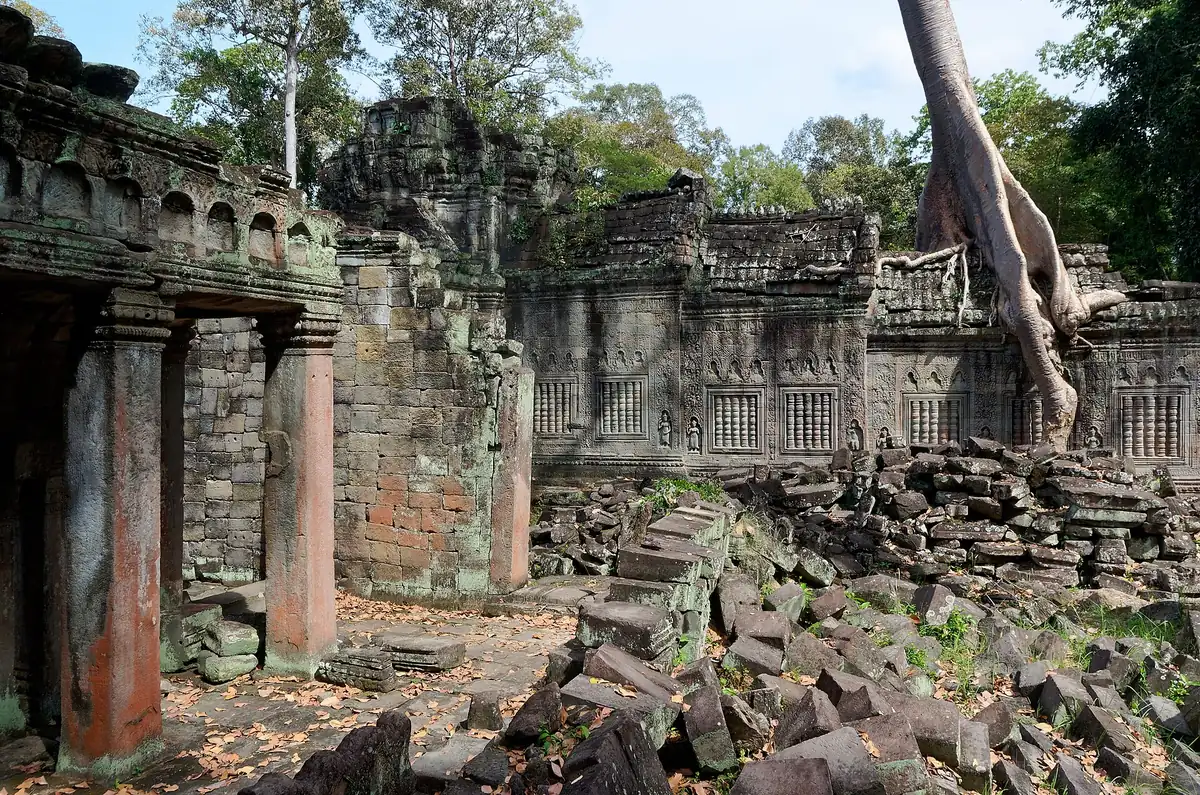
Preah Khan galleries and a tree growing over the stonework. Photo: Jakub Hałun, CC BY-SA 4.0, via Wikimedia Commons
Tours That Reach Preah Khan
Three listings in the catalog stop at Preah Khan. Every price below is the catalog price in US dollars, and in every case the Angkor Pass is not in the tour price and is paid separately.
The Listings That Stop Here
The Angkor Wat 2-Day Tour from Siem Reap Experiences costs $34 per person and stops at Preah Khan on day two together with Pre Rup, Neak Pean, Ta Som and a Phnom Bakheng sunset. The Angkor Pass is not in the price: you buy your own pass online or at the ticket office, and the listing states no amount. Two days of temples need the official $62 three-day pass.
The Angkor Wat 3-Day Tour from Happy Angkor Tour is private, costs $241.75 per person and puts Preah Khan, Neak Pean and Ta Som on day two with East Mebon, Pre Rup, Banteay Srei and Banteay Samre. the checkout adds US$62 per person for the three-day pass at checkout, which makes $303.75.
The Angkor Wat Private Tuk-Tuk Tour covers Preah Khan in its sunset option, along with Pre Rup, East Mebon, Neak Pean, Ta Som and Phnom Bakheng. It costs $20 per group of up to 3, the Angkor Pass is bought separately and the listing states no amount, and meals are not included. This listing is transport only unless you pick the guide option.
Going Without a Tour
Preah Khan is on the standard Grand Circuit, so any tuk-tuk or car driver in Siem Reap can include it on a self-arranged day. Driver prices are reported with a spread you should expect to negotiate around: Wikivoyage lists about US$15 per day for the main temples and US$20 to US$30 for outlying areas, while Nomadic Matt cites about US$25 per day for 3 to 4 people. Buy the pass yourself on the official site ticket.angkorenterprise.gov.kh or through the official Angkor Pass app on Google Play and the App Store, at $37, $62 or $72 depending on length.
Wikivoyage says passes can be paid by credit card, US dollars or riel, and that the riel rate is unfavourable. Dress code applies at every temple: long trousers or a long skirt with covered shoulders, and Wikivoyage says a scarf over bare shoulders is not accepted.
Sources: Wikivoyage: Angkor, Nomadic Matt, Angkor Enterprise.
Preah Khan FAQ
Is Preah Khan worth visiting?
Yes, and Wikivoyage notes it draws fewer visitors than the main temples. Its outer wall encloses about 56 hectares, with 72 garudas on the wall, a Hall of Dancers and an unusual two-storey building, and the World Monuments Fund has maintained it since 1991. Entry is on the Angkor Pass, and the Angkor Wat tickets page explains the buying options.
Is Preah Khan part of Angkor Wat?
No. Preah Khan is a separate temple about 3 km north of Angkor Thom, on the Grand Circuit, built for Jayavarman VII with a stele dating the dedication to 1191. It shares the same Angkor Temples Park pass, which the official site says covers 50+ temples, and the full list of them sits on the Angkor Wat map.
How much does it cost to visit Preah Khan?
The entry cost is the Angkor Pass from the official Angkor Enterprise site: $37 for one day, $62 for three days or $72 for seven days, and children under 12 enter free with their passport. Tours that stop at Preah Khan do not include the pass in their price. The full cost picture is in the what a tour costs section.
Which tours include Preah Khan?
Several listings in the comparison stop here: the Angkor Wat 2-Day Tour at $34 per person, the private Angkor Wat 3-Day Tour at $241.75 per person, and the Angkor Wat Private Tuk-Tuk Tour at $20 per group of up to 3 in its sunset option. The pass is extra in all three. Full details are in the tours that reach Preah Khan section above.
How long do you need at Preah Khan?
Guides to the temple suggest 1 to 2 hours. Plan by size: the walls enclose roughly 56 hectares in an 800 m by 700 m rectangle, which makes it one of the larger sites on the loop. The park opens 5:00 AM to 6:30 PM, so the how many days section helps you split it against Angkor Wat and the Bayon across your pass days.
What else is near Preah Khan on the same day?
Neak Pean, reached by a 200 m wooden causeway with four pools for water, earth, fire and wind, and Ta Som with its fig-covered east gopura, both sit on the same Grand Circuit stretch. One pass covers all three, and the comparison of the three temples above shows what each offers.
What does Preah Khan mean?
Preah Khan means holy sword, and the temple's original name, Nagara Jayasri, meant holy city of victory. Wikipedia records both names.
Which entrance should I use at Preah Khan?
Enter at the east and exit at the west, so you walk the enclosures in sequence, as ABOUTAsia recommends. The east entrance crosses a 100 m causeway over the moat. Penang Travel Tips gives the driver directions from Angkor Thom's North Gate and suggests having your driver drop you at one entrance and wait at the other. A private trip such as the Angkor Wat Private Tuk-Tuk Tour makes that easy to arrange.
What are the opening hours of Preah Khan?
The Angkor Temples Park admits pass holders from 5:00 AM to 6:30 PM on all three passes, per Angkor Enterprise. Siemreap.net lists most circuit temples at 6:00 AM to 6:30 PM, while other travel guides give 7:30 AM to 5:30 PM, so plan around the park-gate times and confirm with your driver.