 Angkor Wat Tours
Phnom Kulen: The Sacred Mountain, Its Waterfalls and How to Visit
Phnom Kulen is the mountain plateau north of Siem Reap where the Khmer Empire declared itself in 802 CE. This guide covers the sacred hill and its national park, the waterfalls, the reclining Buddha at Preah Ang Thom, the quarries that supplied Angkor Wat's sandstone, and how the mountain relates to Kbal Spean, the separate River of a Thousand Lingas. No tour in the catalog goes to Phnom Kulen, so the page also explains what to book instead and what a comparison on Angkor Wat tours shows for the days you do spend at the main temples.
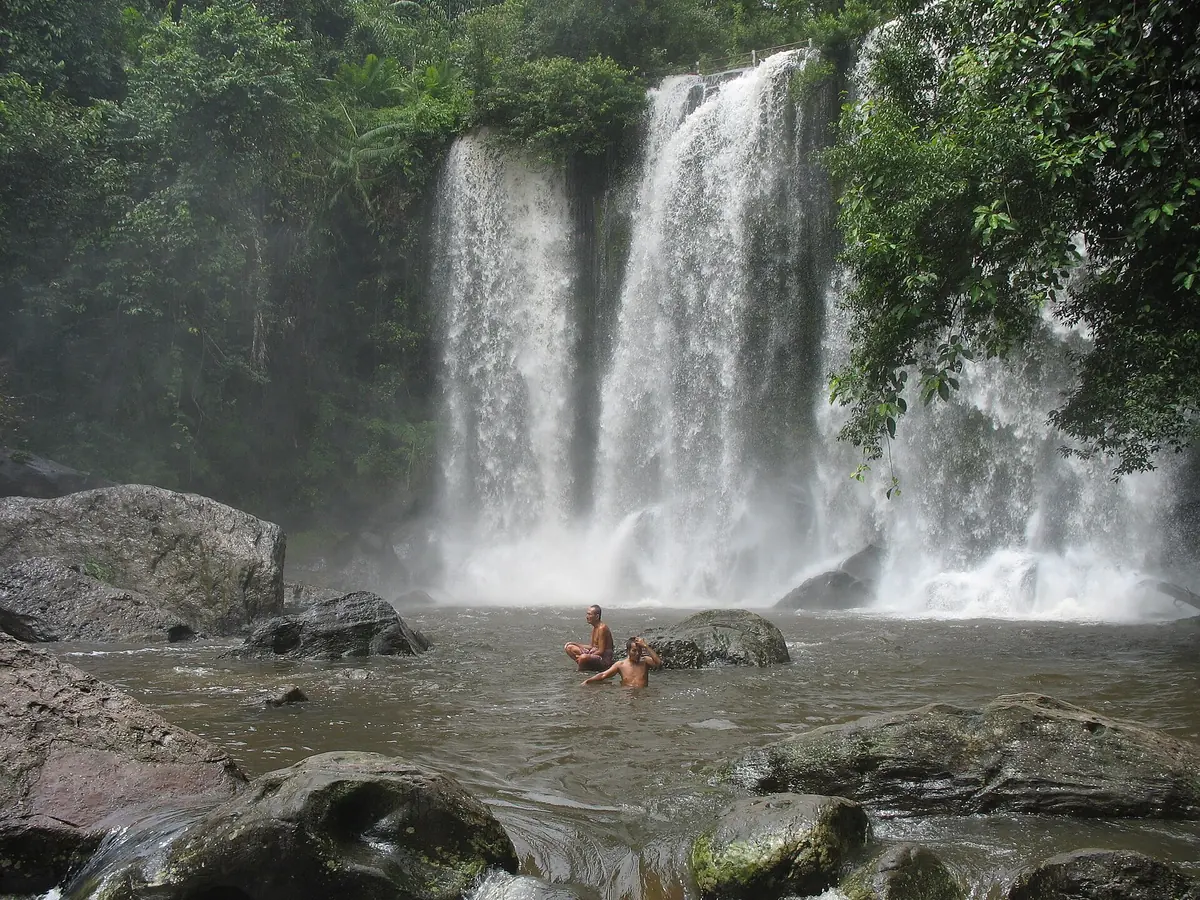
A two-stream waterfall on Phnom Kulen with swimmers in the pool below. Photo: Narith5, CC BY 2.0, via Wikimedia Commons
Quick answer Phnom Kulen in brief
Phnom Kulen is a sandstone mountain plateau about 48 km north of Siem Reap, with a highest point of about 500 m. Jayavarman II was consecrated there in 802 CE, roughly 350 years before Angkor Wat was built. The plateau holds Phnom Kulen National Park, two waterfalls and a reclining Buddha. No tour in the catalog goes there, so you arrange the mountain trip yourself in Siem Reap.
Key takeaways
- The mountain is sacred: the 802 CE consecration of Jayavarman II on Phnom Kulen marks the start of the Khmer Empire, long before the temples in the Angkor Wat tours from Siem Reap guides.
- The park covers 373.76 square km and was established in 1993, with two waterfalls and the monastery of Preah Ang Thom, see What to See.
- Kbal Spean, the River of a Thousand Lingas, is a separate site with its own $5 pass, not part of the mountain, see Getting There.
- No catalog tour visits the mountain. The longest catalog trips are the Angkor Wat 3-Day Tour and the Koh Ker and Beng Mealea Temples Tour.
The Sacred Mountain
Phnom Kulen is where Khmer history as most visitors know it begins, three and a half centuries before Angkor Wat was raised.
802 CE and Jayavarman II
In 802 CE Jayavarman II was consecrated on Phnom Kulen, and the Wikipedia account says he proclaimed independence from Java there. The Mahendraparvata expedition gives 802 as the date of the city's origins on the mountain, about 350 years before Angkor Wat. A 2012 airborne lidar survey, announced in June 2013, helped identify thirty previously unknown temples in the area.
For a traveller the meaning is simple. The temples of the Angkor plain, from Angkor Wat to the Bayon, are the later chapters of a story that starts on this mountain. If you have read the Angkor Wat guide or walked the Angkor Thom walls, Kulen is the preface.
Height and Landscape
The highest point of Phnom Kulen is about 500 m and the plateau averages about 400 m. The sandstone of the plateau matters as much as the height: Angkor Wat's sandstone was quarried at Mount Kulen, about 40 km north-east of the temple, then moved to the plain for construction. The sandstone of Angkor Wat came from this hill.
Kulen National Park
Phnom Kulen National Park covers 373.76 square km and was established in 1993. It lies in Svay Leu district, about 48 km from Siem Reap, while the old city on the plateau lies about 40 km north of Angkor Wat. The park is a protected forest area rather than a temple ticket zone, which is why the Angkor Pass plays no role here, as the Getting There section explains.
Within the park you find the monastery of Preah Ang Thom, the waterfalls, Prasat Koki with its 9th-century Indra statue.
Sources: Mahendraparvata, Phnom Kulen
What to See
The sights on Phnom Kulen range from a 16th-century monastery to river pools under two waterfalls. The table below compares the main stops, with figures from Wikipedia's Phnom Kulen and Phnom Kulen National Park pages.
The Main Stops on the Plateau
The main stops are the reclining Buddha at Preah Ang Thom, the two waterfalls and the small temples and statues between them. The figures in the table come from the Wikipedia pages for Phnom Kulen and the national park.
One caution on names. The riverbed carvings called the River of a Thousand Lingas are at Kbal Spean, a separate site, not on the mountain itself. No dimensions for the reclining Buddha are quoted here.
| Sight | What it is | Note |
|---|---|---|
| Preah Ang Thom | A 16th-century monastery with a large reclining Buddha | A Khmer garuda statue stands on the way to the monastery |
| First waterfall | A fall 4-5 m high and 20-25 m wide | The wider of the two falls |
| Second waterfall | A fall 15-20 m high and 10-15 m wide | The taller of the two |
| Prasat Koki | A temple holding a 9th-century Indra statue | Inside the national park |
| Mount Kulen quarries | The sandstone source for Angkor Wat | About 40 km north-east of the temple |
The Waterfalls in Detail
There are two waterfalls on the mountain. The first is 4-5 m high and 20-25 m wide. The second is 15-20 m high and 10-15 m wide.
How This Differs from Kbal Spean
Kbal Spean is a different place. Kbal Spean is the River of a Thousand Lingas, where about 1,000 lingas were carved into a 150 m stretch of riverbed in the 11th-12th centuries, each about 25 cm square, and a golden linga was consecrated there in 1059. Reaching the carvings means a walk of about 2 km uphill, about 40 minutes per Wikipedia, or 1,500 m per Wikivoyage.
Jean Boulbet found the site in 1969. Kbal Spean has its own $5 pass and its own entry, and the mountain has no such ticket on the official list. Plan them as two separate stops if you want both.
Reclining Buddha Size and the Elephants
Published figures for the reclining Buddha at Preah Ang Thom disagree: Journey Cambodia says 17 m, Take Your Backpack says 16 m and inAsia Travel says 8 m, so treat any number with caution. What is settled is the setting, a 16th-century monastery on the plateau. Further into the park, Islands.com describes Srah Damrei, the Elephant Pond, reached by moto or a 3-mile trail, with large carved animals at its edge, and Damrei Krap, three red-brick towers from the 8th-9th centuries.
Prasat Koki holds a 9th-century Indra statue, and a garuda statue stands on the way to Wat Preah Ang Thom.
Sources: Phnom Kulen, Phnom Kulen National Park
When to Go
Season changes what you see here more than at the Angkor temples themselves.
Dry Season, Crowds and Weekdays
Take Your Backpack recommends November to April, the dry season. December and January are the crowded peak, and for a quieter visit it suggests November or February. The rainy season runs from May to October and turns paths muddy and slippery and limits access and safety.
Journey Cambodia adds that weekday mornings are calmest and that weekends draw Cambodian families in numbers. Because the road up closes to ascending traffic at 11:00 AM, an early start matters in every season.
Source: Take Your Backpack, Journey Cambodia.
Waterfalls, Swimming and the Hike
The falls are the main cooling-off stop on the plateau, and there are two ways to reach the bigger one.
The Walks and the Swim
The first waterfall sits a short walk from the road, about 10 minutes per inAsia Travel. Take Your Backpack describes a Kulen Waterfall trail of about 3 km, taking 1-2 hours at moderate difficulty, leading to the larger falls with natural pools at the bottom. Islands.com calls this an hour-long hike to the falls used in the Tomb Raider film and suggests swimming in shorts and t-shirt, with a change of clothes for after.
Wikipedia gives the first fall as 4-5 m high and 20-25 m wide, the second 15-20 m high and 10-15 m wide, varying with the seasons. In the rainy season from May to October the trails turn muddy and slippery, so wear footwear with grip.
Source: Take Your Backpack, inAsia Travel, Wikipedia.
Getting There
Phnom Kulen sits about 48 km north of Siem Reap, outside the Angkor ticket system, and no catalog tour covers it.
Distance and the Road
Wikipedia puts Phnom Kulen about 48 km north of Siem Reap, and the park page puts the old city about 40 km north of Angkor Wat. Most Angkor temples lie within roughly 24 km east-west and 8 km north-south, while Kbal Spean is about 48 km north, so the mountain and Kbal Spean sit well beyond the day-to-day temple circuits. Read the Siem Reap guide for the town end of the trip.
Tickets and Fees
The Angkor Pass does not cover Phnom Kulen. The official Angkor Enterprise ticket list shows no Phnom Kulen ticket at all, and no official fee for the mountain is published. Siemreap.net reports a separate US$20 ticket for Phnom Kulen, so carry dollars and confirm the amount at the park gate. Kbal Spean, by contrast, has a published price: the official site sells a separate 1-day Kbal Spean pass for US$5, with entry from 6:00 AM and closing at 6:30 PM. The official explore page lists Kbal Spean as a separate area alongside Angkor Wat, Banteay Srei, Koh Ker, Beng Mealea and Chong Kneas.
Because the pass does not apply, a Kulen day sits outside every temple ticket math on the homepage, including the what a tour costs and the Angkor Pass comparison. The Angkor Wat tickets page covers the passes that do apply at the main temples.
Tours: What the Catalog Offers
No tour in the catalog visits Phnom Kulen, and none lists Kbal Spean either. The catalog's farthest day trip is the Koh Ker and Beng Mealea Temples Tour at $50 per person for 8 to 9 hours, which runs east rather than north. Its description names Beng Mealea and Koh Ker, though the itinerary stops list only Beng Mealea, and its entry fees are unclear, so plan for the Koh Ker fee of USD 15 and an Angkor ticket for Beng Mealea. The Angkor Pass is never in any catalog tour price.
For the main temples, the longest comparisons are the multi-day listings. The Angkor Wat 3-Day Tour costs $241.75 per person for 3 days and reaches Banteay Srei and Beng Mealea, with the $62 three-day Angkor Pass added at checkout, which makes $303.75. The Angkor Wat and Floating Village 2-Day Tour costs $235 per group up to 10 and adds Beng Mealea and Tonle Sap on day two. If the mountain itself is the goal, you arrange a car or tuk-tuk in Siem Reap.
Do I Need the Angkor Pass for Kulen?
No. The official ticket list shows no Phnom Kulen ticket, so the Angkor Pass neither covers nor is required for the mountain. The pass matters only if you also visit the Angkor temples the same day. On that side, a one-day pass costs US$37 and a three-day pass US$62 on the listings in this catalog, and every catalog tour prices it separately.
Driving Time and the Early Start
Published driving times vary: inAsia Travel allows about 1.5 hours for the 60 km from a Siem Reap hotel, Take Your Backpack says about 50 km and anywhere from one to two hours, and Islands.com calls it a little over an hour. Wikipedia puts the distance at about 48 km. Plan on leaving Siem Reap by 7:00 AM, because the road up the plateau only takes ascending traffic until about 11:00 AM.
An early start also leaves time for the waterfall before the afternoon descent.
Sources: Phnom Kulen, Angkor, Wikivoyage
What a Kulen Day Costs and How to Get Up There
No tour in the catalog covers Phnom Kulen, so most travelers arrange transport in Siem Reap. Published market rates give a working budget.
Transport, Guides and Cash
Take Your Backpack puts a tuk-tuk from Siem Reap at $15-30, motorbike rental at $5-10 a day and a guide at $30-50, with park meals at $3-7. Islands.com says tuk-tuk rates for two hours start at $10.00 and a jeep with guide runs about $200.00 a day, and it advises against exploring the plateau solo. The drive from Siem Reap is about 48 km per Wikipedia, and published drive times run from a little over an hour to two hours.
Bring cash for the gate, water and a packed lunch, because food options in the park are few. There is no accommodation inside the park, so it is a day trip. If you want a guided day beyond the main temples instead, the Koh Ker and Beng Mealea Temples Tour at $50 per person is the catalog's outer-temple option, and the homepage lists all Angkor Wat tours from Siem Reap.
| Cost item | Take Your Backpack | Islands.com |
|---|---|---|
| Tuk-tuk from Siem Reap | $15-30 | From $10.00 for two hours |
| Motorbike rental | $5-10 a day | Not stated |
| Guide | $30-50 | Not stated |
| Jeep with guide | Not stated | About $200.00 a day |
| Meals | $3-7 | Not stated |
Source: Take Your Backpack, Islands.com.
The One-Way Road: Go Up Before 11
The single road up the plateau runs one way on a fixed schedule. Miss the window and your day changes.
Timing Rules and the Early Start
Islands.com says the narrow road up is open for ascent only until 11:00 AM, after which traffic flows downhill only. Journey Cambodia warns that this one-way access requires strict timing and an early departure. The practical plan: leave Siem Reap by 7:00 AM for the roughly 48 km drive, spend the morning and midday on the plateau, and come down in the afternoon with the downhill flow.
Late starters risk being stuck at the base or losing the waterfall. Weekdays are quieter than weekends, when local families fill the park. This early start is why a day trip here pairs badly with an Angkor Wat sunrise tour on the same morning, so pick one and see the comparison of Angkor Wat tours for the other days.
Source: Islands.com, Journey Cambodia.
Entrance Fee and What It Covers
Phnom Kulen charges its own gate fee, separate from the Angkor Pass. The amount is not on any official list, so this is what published figures say.
What Travel Guides Publish
Journey Cambodia states the Kulen ticket is $20.00 for foreign visitors, paid in cash at a ticket office at the mountain's base, with Cambodians entering free. Take Your Backpack gives about $20.00 in its costs section but about 20,000 riel (about $5) in its FAQ, so the published figures disagree. No fee appears on the official Angkor Enterprise ticket list, which shows no Phnom Kulen ticket at all.
Expect to confirm the amount in cash at the gate.
| Figure | Source | Where it applies |
|---|---|---|
| $20.00 | Journey Cambodia | Foreign visitors, cash at the base gate |
| About $5.00 (20,000 riel) | Take Your Backpack FAQ | Same gate, conflicting figure |
| $5.00 | Angkor Enterprise official list | Kbal Spean 1-day pass, a separate site |
| Not listed | Angkor Enterprise official list | Phnom Kulen itself |
Source: Journey Cambodia, Take Your Backpack, Angkor Enterprise.
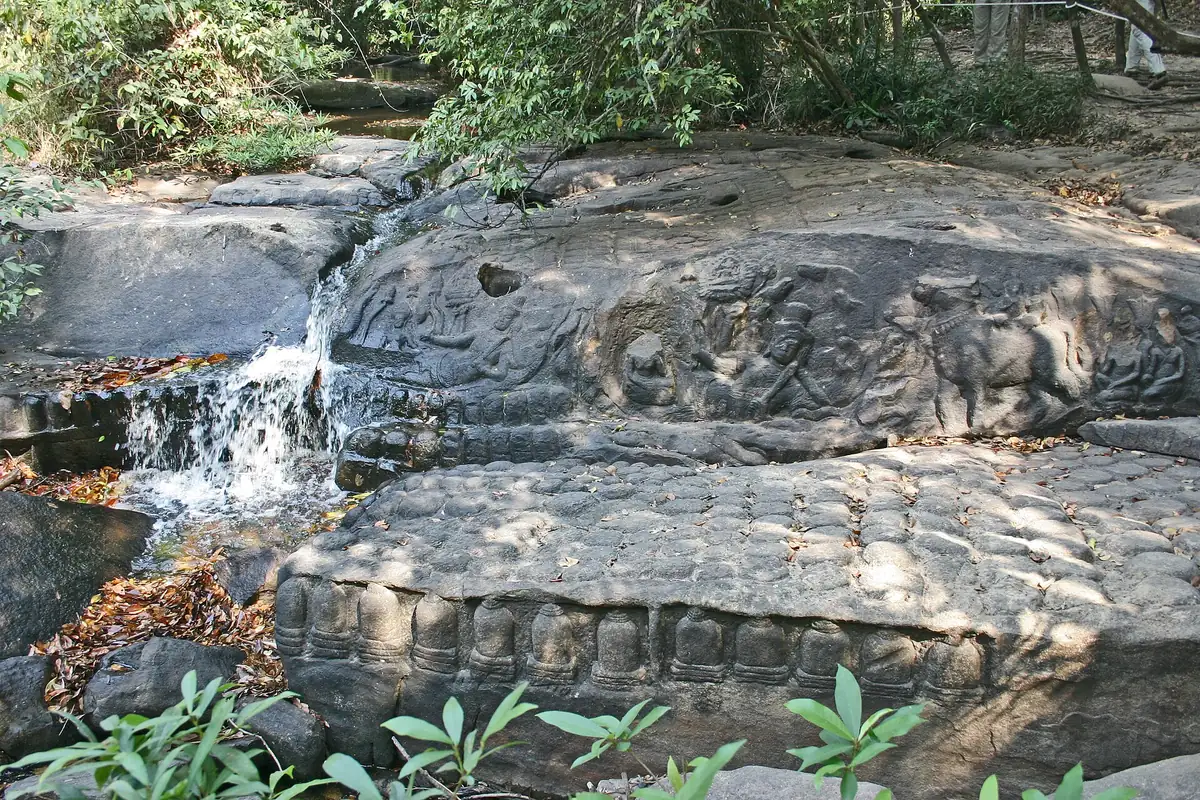
Lingas carved into the riverbed at Kbal Spean on the Phnom Kulen range. Photo: Gerd Eichmann, CC BY-SA 4.0, via Wikimedia Commons
Dos and Don'ts
Simple rules for a Phnom Kulen day.
Do
- Do treat the mountain as a full day because it lies about 48 km from Siem Reap.
- Do ask locally about any park access charge, because the mountain has no ticket on the official list, while Kbal Spean's official 1-day pass costs US$5.
- Do visit Kbal Spean in the dry season because Wikivoyage says drier weather leaves little water in the riverbed, making the roughly 1,000 lingas easier to see.
- Do plan the 40-minute walk to the Kbal Spean carvings because the site requires about 2 km of uphill walking per Wikipedia, or 1,500 m per Wikivoyage.
- Do connect what you see to the temples, because Angkor Wat's sandstone was quarried on Mount Kulen about 40 km north-east of the temple.
Don't
- Don't assume the Angkor Pass covers Phnom Kulen, because the official Angkor Enterprise ticket list shows no Phnom Kulen ticket at all.
- Don't confuse the mountain with the River of a Thousand Lingas, because the lingas are carved at Kbal Spean, a separate site with its own pass.
- Don't book a catalog tour expecting Kulen, because no tour in the catalog lists Phnom Kulen among its visited sites.
- Don't leave the walk to Kbal Spean late in the day, because the official pass runs from 6:00 AM to 6:30 PM and the walk uphill takes about 40 minutes.
Phnom Kulen: Questions
What is Phnom Kulen famous for?
It is the mountain where Jayavarman II was consecrated in 802 CE, about 350 years before Angkor Wat, and it is the sandstone source for Angkor Wat, quarried about 40 km north-east of the temple. See the Angkor Wat guide for the temple the stone built.
How do I go to Kulen Mountain?
You travel about 48 km north from Siem Reap by car or tuk-tuk arranged in town, since the mountain has no ticket on the official Angkor Enterprise list and no catalog tour goes there. The alternatives that are bookable are on the multi-day tours section of the homepage.
How much does it cost to enter Phnom Kulen National Park?
No official fee is published and the official ticket list shows no Phnom Kulen ticket, so ask about the access charge locally. What is published is the separate Kbal Spean pass at US$5, explained in the getting-there section.
Is the River of a Thousand Lingas at Phnom Kulen?
No. The over 1,000 riverbed lingas are at Kbal Spean, a separate site reached by a walk of about 2 km uphill per Wikipedia, and it is described separately from the Kulen waterfalls.
Can I swim at the Phnom Kulen waterfall?
No swimming rules are published, so ask locally. The first fall is 4-5 m high and 20-25 m wide, the second 15-20 m high and 10-15 m wide. For water of a different kind, see the Tonle Sap guide.
Where does the reclining Buddha on Phnom Kulen sit?
The reclining Buddha sits at Preah Ang Thom, a 16th-century monastery on the plateau, with a Khmer garuda statue on the way there and Prasat Koki holding a 9th-century Indra statue in the same national park. The monastery is one of the sights compared in the table on this page, alongside the temples covered by the Angkor Wat map.
When is the best time to visit Phnom Kulen?
The dry season from November to April per Take Your Backpack, with weekday mornings quietest per Journey Cambodia. December and January are the crowded peak, and the rainy season from May to October leaves trails muddy. Go early regardless, because the road up takes ascending traffic only until about 11:00 AM.
Can you swim at the Phnom Kulen waterfall?
Yes, travelers swim in the natural pools below the falls in shorts and t-shirt, with a change of clothes for after, per Islands.com and Take Your Backpack. Take Your Backpack describes a trail of about 3 km taking 1-2 hours at moderate level to the larger falls, and Islands.com calls the hike to the Tomb Raider fall an hour long. The park's own swimming rules are not published.
Which waterfall was in Tomb Raider?
Islands.com identifies the larger of Phnom Kulen's two waterfalls, reached by an hour-long hike, as the fall used in the Tomb Raider film. The first fall sits closer to the road, about 10 minutes away per inAsia Travel, so you can see both on one morning if you start early enough to beat the one-way road cutoff.